Introduction
The impeachment of South Korean President Yoon Suk-yeol has ignited widespread discussions not only in Korea but also around the world. This momentous event, driven by a groundswell of civic action, represents more than just a political reckoning—it signifies the power of democratic engagement in the modern era.
This post offers an in-depth look at how this impeachment unfolded, the constitutional and political framework surrounding it, and why it’s being hailed by many as a victory for the Korean people. Designed for a global audience, this detailed narrative aims to shed light on the causes, process, and implications of this historic event.
Part 1: The Background and Spark of Civil Unrest
The Rise of Yoon Suk-yeol
Yoon Suk-yeol was elected as President of South Korea in 2022, following a career as a prominent prosecutor. Known for his tough stance on crime and law enforcement, he campaigned on promises of reform, economic revitalization, and strong national defense. However, soon after taking office, criticism began mounting regarding his governance style, policy decisions, and alleged authoritarian tendencies.
Mounting Discontent
Several key issues triggered nationwide discontent:
- Economic Mismanagement
Inflation surged during Yoon’s administration, while housing prices remained volatile. Many citizens felt the president prioritized the wealthy elite and corporate interests, neglecting the middle and working classes. - Suppression of Dissent
Journalists, academics, and even civil rights activists reported increased censorship, legal intimidation, and surveillance—raising concerns over freedom of speech and democratic backsliding. - Foreign Policy Concerns
Yoon’s alignment with certain international powers, particularly a shift toward militarization and confrontational rhetoric, alienated segments of the public who preferred a diplomatic approach toward North Korea and regional allies. - Scandals and Nepotism
Accusations of corruption involving close aides and family members further fueled public outrage. Investigations pointed to misuse of power, questionable appointments, and lack of transparency.
Part 2: Civic Action and Legal Momentum
The Role of Civil Society
South Korea has a strong tradition of civil activism. From the Candlelight Revolution in 2016 that led to the impeachment of President Park Geun-hye to the recent protests, Korean citizens have shown an unwavering commitment to holding leaders accountable.
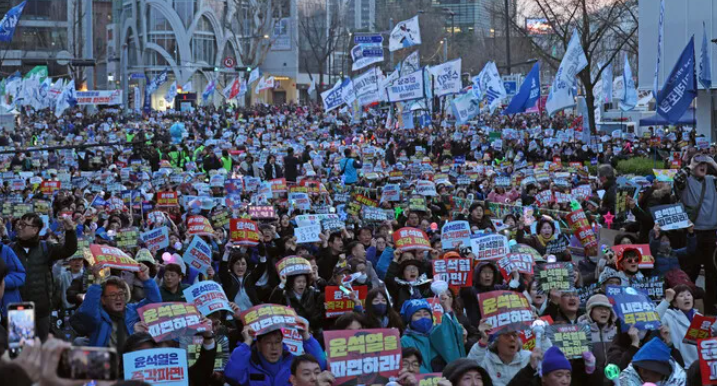
In the case of Yoon Suk-yeol, massive protests emerged across major cities including Seoul, Busan, and Gwangju. These demonstrations were not only large in scale but diverse in demographic makeup—students, elders, union members, and religious groups marched together under the banner of democratic integrity.
Social Media and Digital Mobilization
Social media platforms played a critical role in organizing and amplifying dissent. Hashtags like #ImpeachYoon and #DemocracyFirst trended globally. Livestreams of protests, digital petitions, and grassroots campaigns galvanized international attention and solidarity.
Legal Proceedings and Parliamentary Action
Amid overwhelming public pressure, opposition parties in the National Assembly initiated formal impeachment proceedings. Citing constitutional violations, abuse of power, and gross misconduct, lawmakers pursued a motion under Article 65 of the South Korean Constitution, which allows for presidential impeachment.
The impeachment motion passed in the National Assembly with a supermajority—an indication that even some of Yoon’s former allies had turned against him.
Constitutional Court and Judicial Review
After the National Assembly vote, the case was referred to South Korea’s Constitutional Court. Unlike some nations where impeachment is largely political, Korea requires judicial review to finalize the process.
The Court undertook a thorough investigation, calling expert witnesses, reviewing state records, and even accepting citizen-submitted evidence. After weeks of deliberation, the Court ruled unanimously in favor of impeachment, citing violations of democratic principles, civil liberties, and the Constitution.
Part 3: Reaction and Global Significance
National Reaction
Celebrations erupted across the country following the Constitutional Court’s decision. Many Koreans viewed the outcome as a triumph of justice, democracy, and civic courage. The media described it as “a people-powered correction to executive overreach.”
Though some segments of society remained loyal to Yoon and expressed dissent, the prevailing sentiment was one of relief and renewed hope for democratic renewal.
International Response
World leaders and human rights organizations closely observed the events. The impeachment was largely seen as a reflection of Korea’s mature democracy. While some conservative governments expressed concern over political instability, others lauded the peaceful and lawful resolution of a national crisis.
Political analysts in the U.S. and U.K. drew parallels with other populist leaders globally, noting that South Korea’s response—through civic engagement and legal channels—could serve as a model for democratic resilience.
Part 4: The Aftermath and Transition of Power
Interim Leadership and Political Stabilization
Following the Constitutional Court’s ruling, President Yoon Suk-yeol was officially removed from office. According to South Korean law, the Prime Minister assumed the role of acting president until a new national election could be held within 60 days.
This interim period was marked by efforts to restore public trust in government institutions. Key reforms were introduced to enhance transparency, judicial independence, and press freedom—areas that had come under intense scrutiny during Yoon’s presidency.
Special Prosecutors and Investigations
With Yoon’s immunity stripped, prosecutors launched formal investigations into alleged corruption, abuse of power, and misconduct during his tenure. Some of his aides and family members were called in for questioning. Several high-profile indictments followed, leading to speculation about potential jail time for the former president.
The investigations were conducted with an unusual level of transparency, often livestreamed or publicly summarized to maintain civic trust. This was widely praised as a new benchmark in Korean political accountability.
Part 5: The People’s Voice and the Role of the Media
Citizens as Catalysts for Change
The impeachment of Yoon Suk-yeol is often described not simply as a legal or political victory, but a civic revolution. The Korean public’s tireless efforts—through protests, petitions, and peaceful resistance—were instrumental in pressuring the political system into action.
Grassroots movements, many led by youth and first-time activists, emphasized themes of dignity, democracy, and future generations. The moment became a civic awakening, fostering increased voter registration, political education, and public dialogue on systemic reform.
Independent Media’s Role
While traditional media faced pressure and threats under Yoon’s government, many independent journalists and digital outlets stepped in to provide accurate reporting. Investigative journalists unearthed critical documents, whistleblower testimony, and financial records that helped build the case for impeachment.
The global press, including outlets like The Guardian, The New York Times, and Le Monde, covered the story extensively, framing it as a watershed moment for democratic resilience in East Asia.
Part 6: Global Reflections and Comparative Lessons
A Model for Constitutional Democracy
The Yoon Suk-yeol impeachment case is now studied in political science and law departments around the world. It is seen as a prime example of how democratic institutions—when supported by civic pressure and media integrity—can successfully check executive power.
Observers in the United States, United Kingdom, and other liberal democracies have noted several key takeaways:
- A vigilant civil society is essential to protecting democratic norms.
- Independent courts can serve as neutral arbiters even in politically charged cases.
- Social media, though often criticized, can be a tool for organizing peaceful civic action.
Inspiration for Struggling Democracies
In nations facing democratic backsliding, particularly those dealing with populist or authoritarian leadership, the Korean model is an inspiring blueprint. It underscores that constitutional tools, public engagement, and a free press remain vital pillars of modern democracy.
International NGOs like Amnesty International and Human Rights Watch issued statements praising Korean citizens for their nonviolent resistance and democratic advocacy.
Conclusion: A Democratic Legacy for the Future
The impeachment of President Yoon Suk-yeol is more than a domestic political event—it is a defining chapter in the global narrative of democracy in the 21st century.
It showed that no leader, regardless of popularity or power, is above the Constitution. It reminded the world that ordinary citizens—when united—can stand against injustice, uphold democratic values, and shape the future of their nation.
As South Korea now moves into a new era of leadership, the lessons from this crisis will undoubtedly shape its political landscape for generations to come. The people’s victory wasn’t just about removing a president—it was about reaffirming the spirit of democracy itself.
Stay informed. Stay engaged. Democracy is not a given—it’s a shared responsibility.